
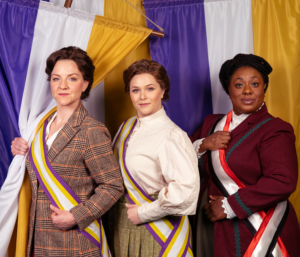
 How do you make the suffragist movement upbeat and exciting? Director Chelsea Anderson is taking history from the page to the stage with a contemporary twist!
Discover how Chelsea is approaching her rendition of the Tony Award-winning musical Suffs, including some hints for who and what you may see on stage.
Q: Tell us about the storyline.
Anderson: This is a fantastic new musical. It is all about the women who pass the right to vote for women. They got it passed in 1920, and so this is all of their story.
We’re very familiar with the Susan B. Anthony side of that world, but this part of the world introduces us to Carrie Chapman Catt, Alice Paul, Ida B. Wells, Mary Church Terrell, and all of the fantastic women who worked tirelessly for years to get suffrage passed. It’s really an inspiring story. It’s funny, it’s heartwarming, and it shows both the struggle and the triumph of all of that work.
Q: Can you describe the set?
Anderson: This one’s going to be a little different than what folks might be used to on the Hormel Stage. In the past, audiences have seen unit sets on our stage or moving pieces in and out, big walls, things like that, but on this piece I worked with our designer Yoon, who is wonderful and has worked with us in the past, and I really talked about the metaphorical side of what this world does and how the story is told.
I think it’s really important to think about the road that we’ve come from and think about the road that we’re still heading down in order to get rights for all people and all of these things that we’re up against and what we came from before, so the scenic design has this feeling of a road that goes off into the distance, and we get to see a lot of open space on stage so that our actors can occupy that space in a different way.
I think it’ll be a really striking image on the stage.
Q: Please describe the main characters..
Anderson: We have a lot of primary characters in the show. There are 18 women who will be on stage and we have our four swings as well, who will be studying everybody on stage to learn so many roles. But of those, there are a lot of big names that we’ll see.
There is the younger generation and that includes Alice Paul, who’s our ringleader, and she’s the one with all the gumption who gets out and rallies the troops to get them to go forward with these ideas and plans.
There’s her best friend Lucy, who is sort of a mother of the group. She is a practical person, but she likes to have fun with everybody and is very sympathetic and empathetic to everyone working through these struggles. Inez Millholland, who is very famous. Inez is the socialite turned lawyer who is a really big part of this movement and there’s actually a very famous photo of her on a horse that you will see come up, and you can actually Google it and find her. It’s iconic for this movement.
We have Doris Stevens, who is the secretary of the group and the youngest member of the team, coming in and keeping track of everything. And then we have Ruza, who is a Polish immigrant who is fighting for workers rights and joined the suffrage movement.
Then we have an older generation cohort, which includes Carrie Chapman Catt, who is that legacy figure in the women’s rights movement. She is joined by Ida B. Wells, who, of course, is an iconic journalist from the time, Mary Church Terrell, who is an advocate and really a fierce academic at that time when women weren’t necessarily allowed to be academic, and she’s also a black identifying woman. On top of that, Ida B. Wells, of course, is black identifying as well, and these women were making huge strides in their communities and for society as a whole.
The older contingency has a different way of looking at things than the younger contingency, thus creating some conflict in our show.
Q: What important historical events are highlighted in this show? What kind of research did you do to prepare for Suffs?
Anderson: There are so many events. We, of course, have the fight for the vote for women, and that spans several years. We see about seven years in the show. We get to see World War I kicking off. We get to see the women’s first marcharch, the first ever march on Washington that women did that was led by Alice Paul and all of these wonderful women, and we get to see when we get the right to vote.
We’re introduced to Woodrow Wilson, who was played by a woman, and it’s fantastic. Jane Bunting* will be taking care of that role for us, and it’s such a cool way to look at these historical figures through a different lens. So we get her wonderful artistry, playing this bombastic, ridiculous character in a way that really creates this eccentric conflict in the play for the women.
There’s so much history in this play, but it’s just light and fun and energetic, and it certainly doesn’t feel like a history.
Q: What is the biggest challenge in directing a show like this?
Anderson: There’s just so much going on in the script. It’s a wordy script, but it moves really fast and the lyrics are so interesting. They carry so much imagery and metaphor in them, and I think making sure that all of that is highlighted in a way that makes sense for the audience, but it also doesn’t bog down their experience of watching the show.
We want to see these people move through time and move through their struggles in a way that makes sense, and that we can cheer them on and rally for these women doing what they’re doing. So, the most difficult side of that, I think, is balancing the joy of watching this wonderful piece of theater with that side of thinking about the text and thinking about the imagery, as I mentioned, and the metaphor in this so that we can kind of balance both sides and have a really lovely night at the theater.
Q:How are you approaching the themes of discrimination and civil rights in this show?
Anderson: It’s an important part of this history and it’s an important part of this show. I’m so thrilled that Shaina Taub included it in the text and included it as a part of the arc of these women, because the women face their own prejudice in certain ways, and they have to overcome that and recognize, “oh my gosh, I didn’t even know I had that bias and now I have to overcome it and make amends for some of those things”.
We get to see not only the fight for what womanhood is and was at that time, but equally seeing that within that same mission and within that same drive and that goal, we still have this fracture because there’s a misunderstanding in our culture and there’s a misunderstanding between communities. I think the beauty of this show is that we can all have a similar goal and learn to say, “I’m having a disconnect here because it’s something I don’t experience, so I need to figure out how I’m disconnecting and how I can reconnect to make sure that I’m supporting everybody and that it doesn’t become this fractured, isolated, siloed conversation when we’re all fighting for the same goal, which is equality”. And that equality looks different depending on your experience in the world.
So equity is almost a better way to talk about it, because we have to look at all of these different parties and all of these different individuals and ensure that they’re getting an experience that is achieving the goal, achieving this broader idea, but equally looking at what the struggle really was.
I’m thrilled that we have such a wonderful cast of individuals who come from many different backgrounds, many different life experiences, who can speak to things that I don’t know, can speak to things that I’m not well versed in because it’s not my personal experience, to make sure that we have a sensitivity around that conversation, but equally understanding that the point of the story is to point out the insensitivity in certain places.
Being able to have that conversation with an open hand and say, “let’s talk about this”, as opposed to “here’s what you should think”. It’s very much an open conversation with us within the cast, with the audience, with the design team, with the text, with these characters, with history. I think keeping that open conversation is how we can avoid some of the pitfalls of feeling depressing or feeling like we are approaching something without understanding what it is we’re talking about.
Q: Which relationship in the show do you find most interesting?
Anderson: If I have to pick just one relationship that I like, that’s going to be so challenging. I think it has to be Alice and Inez because they have an unspoken language that some of the other women in the story don’t necessarily have access to. Just between the two of them. They’re able to understand each other without having a long, drawn out discussion.
They’re able to sense in each other certain things that are happening to the other one, or what they need to do. They can navigate that psychology in a different way than even women who have known each other longer in the course of the show. It’s just this really fast, tight connection between those two women. They’re both incredibly intelligent.
They are so autonomous. They both have a real sense of understanding of themselves and the power that they hold as individuals, as women, as smart women. They connect on such a beautiful level. It’s something I aspire to in the friendships that I have and the relationships I have, and I have to say, I’m thrilled to be working with Lauren Stannis as my Assistant Director and Choreographer on the show, because I think she and I kind of have that.
We’ve been friends for a while now, and we do have a bit of a second hand and a shorthand that we can talk with each other. I’m excited to see what she puts into the show and how her brain works on this show.
I’m just really thrilled that I get to experience that in real life and then see it play out on stage as well.
Q: When people hear a musical about the women’s suffrage movement, they might expect a history lesson. What would you tell them to dissuade them from thinking that?
Anderson: In all honesty, it does not feel like a history lesson. There are so many parallels to our experience of the world today. It’s, you know, by definition political. It’s about politics, but equally it’s more about these women and what these women are experiencing in trying to say, “hey, I’m a person, can I person please?”, and what that feels like and what they’re up against in this world so it doesn’t feel like a history at all.
It is exciting. You get wrapped up in it. I sort of think of it like Apollo 13, the movie. I don’t know how many times I’ve seen that. We all know the outcome, but every time I’m like, “are they going to make it? Are they going to come back?”
You got to watch it. Suffs has a sense of, “are they going to get it? Is this the time they get it? What happens next?” It really has this energetic movement. And of course, the main narrative in the story, the sort of touchstone that we come back to often is this idea of marching.
So they do the first March, they talk about continuing the march. There’s the song Keep Marching at the end. That metaphor of the road that I spoke about with our scenic design comes into play here because in the whole thing, there’s a momentum and an inertia to the storyline that you can’t help but get caught up in. And so it really feels like we’re moving on this fantastic journey.
And by the end of it, you go, “I didn’t even realize I learned a bunch of stuff, but I did”. It’s just an exciting show to watch.
Q: What do you hope audiences take away from the show?
Anderson: I really think of it as a call to action. The show is a call to action, not only to support your fellows, not only to speak your mind and to advocate for what you believe in, to make sure that others get to experience the world in a way that is not barring them from anything. But it’s a call to action to think about what’s going on in my local community, what’s going on in the politics around here because no matter what, whatever side you’re on, local politics are key.
National politics don’t change without local politics. And I think that’s the call to action. There’s really something to be said about coming together as a people and saying, “how can I help?”
Let’s look to the helpers. Let’s look to the people who are supporting, and how we can be a part of that rather than sitting back and waiting for someone else to do it, or taking all the time we have to be able to give if we want to be able to receive.
Event Details
What: Suffs
When: October 14 – November 29
Where: The Phoenix Theatre Company, Hormel Theatre, 1825 N. Central Ave., Phoenix, AZ 85004
Tickets: Available at www.phoenixtheatre.com or by calling the Box Office at (602) 254-2151
Click here to watch the full recording of the Director’s Download.
Photo: (Cassie Chilton* as Alice Paul, Elyssa Blonder* as Lucy Burns, & Chanel Bragg* as Mary Church Terrell. Photo by Brennen Russell. *Courtesy of Actors Equity)