By The Phoenix Theatre Company
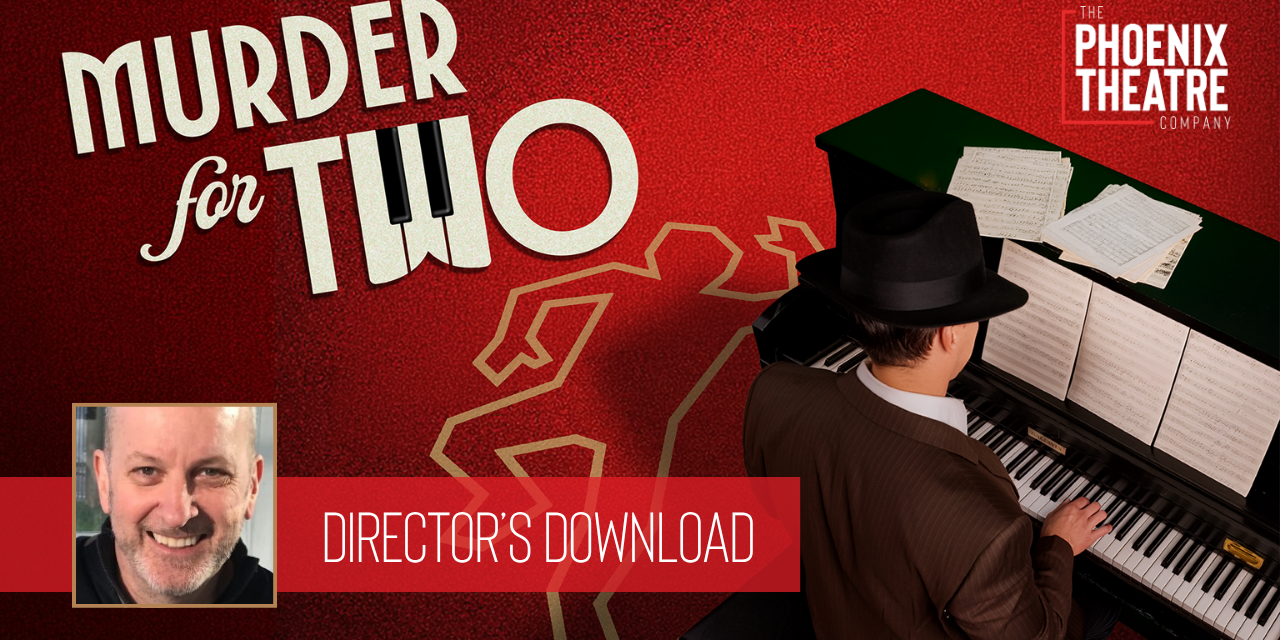
Director Rod Kaats chats with us about Murder for Two and gives us a peek inside this fast-paced musical murder mystery comedy. He may have even revealed the identity of the murderer off-camera, but no spoilers here! Two actors. Ten suspects. One piano. Tickets are on sale now!
Q: Please tell us about Murder for Two.
Kaats: Murder for Two is a two-hander musical. It’s called “two-handers,” when you talk about something that [only] has two [actors] in it. The musical is typically done with two actors who also play the piano. Those actors are both playing the piano and also trying to play the parts. But of course, there’s a limit to what they can do because their hands, or at least one of their hands, is
glued to the piano at all times. This production is conceived by Michael Barnard, Producing Artistic Director, who wanted to do it a different way, which is to have a separate piano player. Alan Plado, who is our musical director, is also going to be the pianist in the show. So, the actors will be liberated from that. We’ll get to do a different way of doing it than normal.
Q: The Phoenix Theatre Company did Murder for Two on our outdoor stage during the 2020 lockdown. Those audiences saw it outside with an extra piano player. What will this be like, seeing it indoors?
Kaats: First of all, it will be cooler and more comfortable to be indoors in a dark theatre than it would have been to be outside in the summer. That may be the biggest difference in the audience’s experience. Also because when you’re indoors, you can create a different kind of universe, right? This plays with all the classic comic murder mystery tropes, including a sort of mysterious mansion and doors that slam and dead bodies that are lying around and multiple suspects. Because we’re indoors, we’ll be able to create a more mysterious atmosphere and be more playful with the visuals in the show. When you’re outdoors, everything is exposed in the sunlight. It’s harder to create that artificial mystery. I think in essence, it will be cooler, more comfortable, and more mysterious and fun.
Q: Can you please describe the main characters?
Kaats: There’s two actors that play multiple roles. One of the actors plays Marcus Moscowicz, who is the detective. He pretty much plays that role throughout the entire evening. He does voice a couple of other characters when he’s telling a story, but essentially he’s playing that role. He’s the classic gumshoe detective. Then, there’s all the suspects in the show. There’s [several] of them and one actor in a sort of tour-de-force plays all those other characters, several of whom are women. And then we have a lot of fun when we have to have both multiple suspects on stage talking to the detective at the same time. But we only have one actor playing all those things. What we’ll get to do in this production, since he’s not tied to the piano, is to have a little bit more fun with the theatricality of that, switching from one part to another in sort of rapid fire succession. We hope it is very comedic.
Q: How are you going to make each character instantly recognizable?
Kaats: That’s a great question. I directed The Lehman Trilogy at The Phoenix Theatre Company too, and there was a similar thing where the actors played multiple roles. We were really concerned about the audience not getting confused about who was who. The primary way that’s going to be done is with voices. There are several scenes where the characters that he’s playing are talking to each other. He’s going to have to say, “this is this character and that is that character.” Primarily, it will be the voice. We’ll do a little bit with costuming and posture. Then, I just think we’re going to have some fun with the silliness of it all.
Q: The music feels like its own character. How are you going to stage that in the story?
Kaats: Alan Plado’s our musical director, and will also be on stage playing the piano. There is a piano in the center of the stage that’s on a turntable, so it will spin. When the music director is present, he can be in the room. And when we don’t need him to be, he’s not necessarily right there in the center. The music is very sort of vaudevillian music hall. It will all be done with an acoustic piano. If you can imagine yourself going into a turn of the century vaudeville theatre with a red curtain and a guy plays the piano and then tell some jokes, it has that kind of feeling. It’s very playful music hall type music. And. Yeah, I mean, I think that’s the biggest characteristic of it to talk about. And it’ll be fun to have Alan there. So there’s one actor that plays the detective, there’s another actor that plays all of the suspects. And then there’s an unseen character called “Lou,” who is the detective’s sort of other buddy that works with him in the station. And in the play, Lou is silent. Since we’re doing a slightly different version of the play where we don’t have both of the actors at the piano, I’ve decided, “Alan, guess what? You’re Lou.” One of the things about this play is that it’s so it’s so unafraid to be silly and playful and the fun of doing it in a different way now is we have to find different solutions for that playfulness. I think we’ll have a lot of fun with Alan, who’s like, “What do you mean? I’m Lou? I’m playing the piano. Who am I? What am I doing?” That’s sort of how we’re going to get that double hit out of that piano in this version.
Q: What specifically excites you about the show?
Kaats: Oh, so many things. I’m so excited to be back at Phoenix Theatre Company directing again. It’s such a great group of people and, a great team of designers, all of whom are new to me and different than the team that we worked on with Lehman Trilogy. I have a great time collaborating with Michael Barnard, the Producing Artistic Director, who always has really smart things to say and challenging questions. And so it’ll be fun to work with him again. The thing that I’m most excited about is also the thing that I’m the most afraid of, which is like, how do we do it? The thing about working in this way that I described, where you make it up in the room, I think makes for very lively and very playful snap, crackle, pop kind of theatre. But it is nervous making, right? There’s an element of danger and risk there too.
Q: So what do you hope audiences will take away from the show?
Kaats: Well, I hope you know we all need we need a break. It’s like on a Sunday when you go out for some dinner, and you’re with your family. Then, everybody gets to stop and have an ice cream cone. For a little while, you forget your troubles. It feels good. It tastes good. You spill it on your hand and all your clothes, and you get that sweet taste in your mouth. It gives you just a little moment of relief from life’s tensions. And I think there’s absolutely not only nothing wrong with that, but that’s something that is really important for theatre to do. And the fun of that, just like eating an ice cream cone with your family or friends, is you get to do that in a room full of people together and have that kind of communal experience is really great. You’re hearing music, you’re laughing, and you’re in a comfortable room in a chair at a theatre company where you have friends, where you’ve been entertained before. I think it’s a really special thing to go to the theatre. And this is just the ice cream cone version of that. And I think that’s really great on a hot summer day. It’s just fun.
Details
Dates: August 26 – September 20, 2026
Location: The Phoenix Theatre Company, Hormel Theatre
Tickets: phoenixtheatre.com | (602) 254-2151
Audio Description and American Sign Language interpretation are available for this production. Performance dates and details can be found at phoenixtheatre.com.
Click here to watch the complete Director’s Download with Rod Kaats.
Click here for a PDF of the full article.