
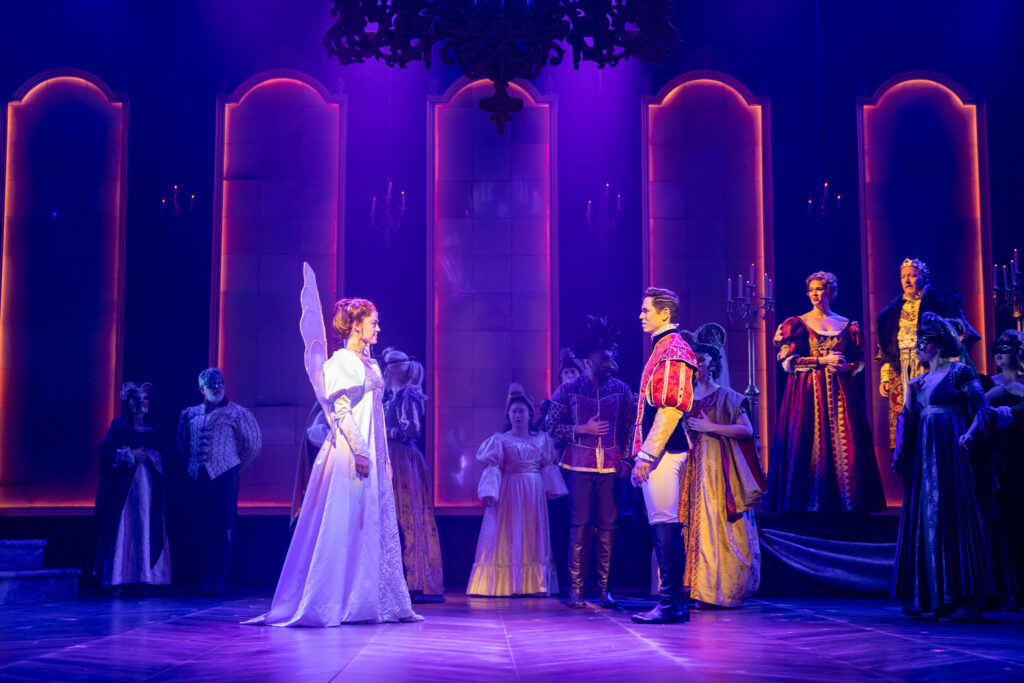
The Cast of Ever After (Photo by Brennen Russell)
At first glance, Ever After appears to be another retelling of Cinderella: a cruel stepmother, a mistreated young woman, a prince, a ball, a lost shoe. But the story’s lasting emotional power comes from the fact that it refuses to operate primarily as a fairy tale.
Instead, it becomes a story about grief, dignity, class, intelligence, emotional loneliness, and the difficult work of becoming worthy of love.
What separates Ever After from most Cinderella adaptations is that it removes magic and replaces it with psychology. There is no fairy godmother waving a wand to transform destiny. There are only people, flawed, wounded, yearning people making choices. That single creative decision changes the entire meaning of the story.
Danielle is not “chosen” by fate. She survives because of character.
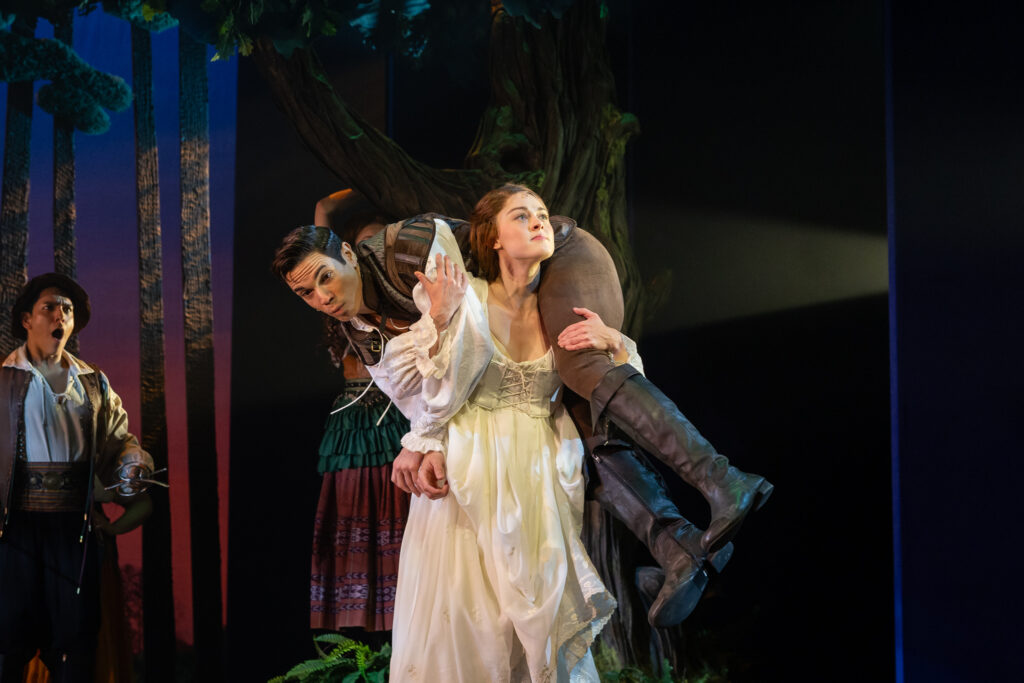
Alexandro Partida as Ensemble, Jason Gotay* as Prince Henry, and Bailee Endebrock* as Danielle
(Photo by Brennen Russell)
In many versions of Cinderella, the heroine is passive. Good things happen to her because she remains pure and patient. But Danielle de Barbarac is active in every part of her own life. She rescues servants. She debates philosophy. She steals back what belongs to her. She physically carries the prince on her shoulders at one point in a deliberate reversal of fairy-tale gender expectations. Even when she dreams of freedom, she does not wait helplessly for salvation. That matters because it makes her recognizable as a human being rather than a symbolic archetype.
The story allows Danielle to be angry, stubborn, impulsive, embarrassed, compassionate, idealistic, and exhausted. She is not the “perfect goodness” embodied. She is a person trying to retain her moral center in circumstances designed to strip it away. Her suffering is not stylized into fantasy; it feels social and economic. She lives under dependency, emotional manipulation, and class vulnerability. When her father dies, her world changes not because of magic, but because inheritance laws and patriarchal structures leave her powerless. That is profoundly human.
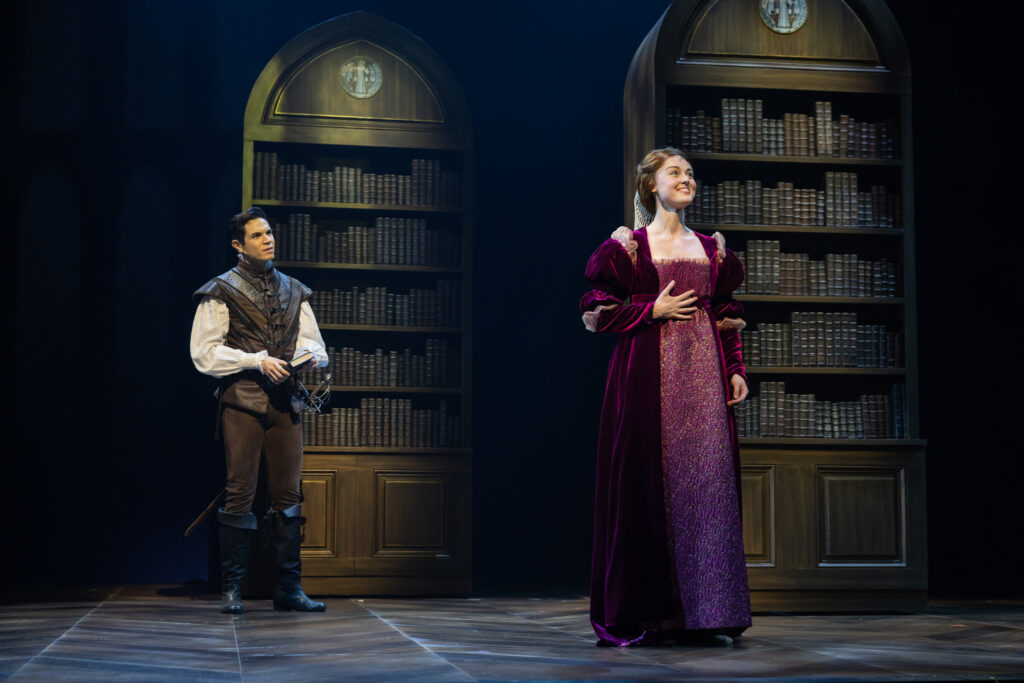
Jason Gotay* as Prince Henry and Bailee Endebrock* as Danielle (Photo by Brennen Russell)
The story also humanizes the prince in a way most fairy tales never attempt.
Prince Henry begins not as an ideal romantic figure but as an immature young man terrified of responsibility. He is shallow at times, performative, entitled, and uncertain of himself. The story is not merely about Danielle becoming “worthy” of a prince; it is equally about Henry becoming worthy of Danielle. That shift is essential.
In traditional Cinderella stories, the prince is often little more than a reward mechanism with handsome royalty validating the heroine’s virtue. But Ever After asks a more complicated question: what does power do to a person, and can privilege coexist with genuine humanity?
Henry must learn empathy. He must confront his cowardice. He must understand that admiration is not love and possession is not partnership. Danielle challenges him intellectually and morally, not just romantically. Their relationship develops through conversation, disagreement, and mutual influence. They are changed by each other. That is the structure of a human love story, not a mythic fantasy.
Another reason the story feels human that nearly every major character is shaped by loss or fear. Danielle loses her father and spends the rest of the story trying to preserve the moral world he represented. Henry struggles under the emotional distance of royal expectations. Even the Baroness Rodmilla is driven by fear after social and financial instability threaten her daughters’ future. The show never excuses cruelty, but it explains it emotionally rather than mythologically.
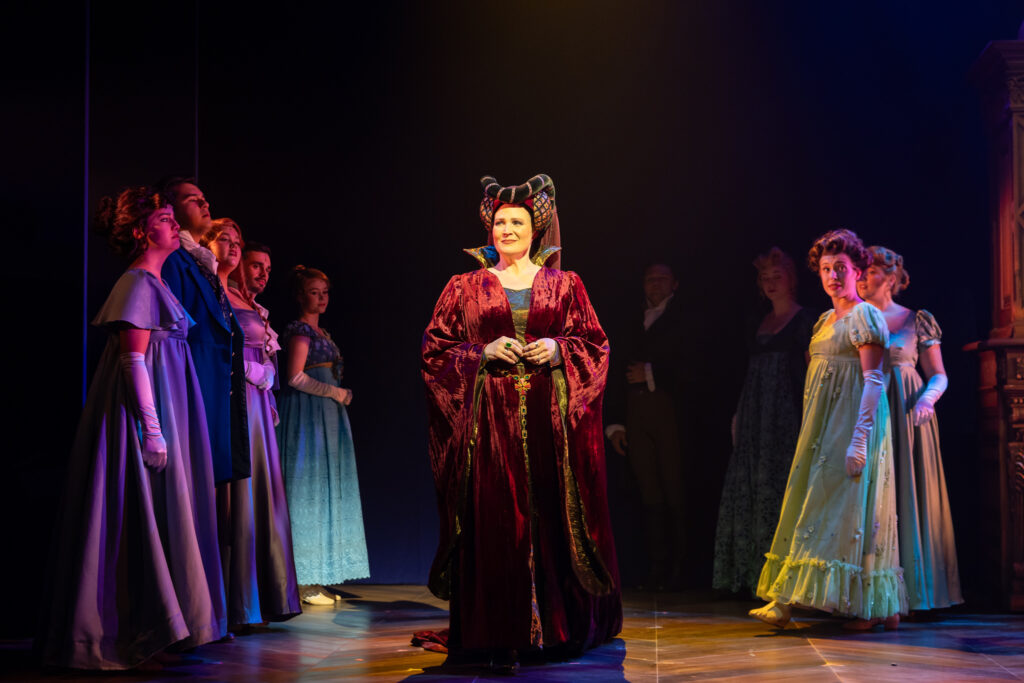
The Cast of Ever After (Photo by Brennen Russell)
Rodmilla is especially important because she is not portrayed as evil in the abstract. She is vain, class-conscious, resentful, and emotionally damaged. She sees Danielle as a living reminder that her husband loved another woman more deeply than he ever loved her. Her cruelty emerges from insecurity and humiliation. Again, that is painfully human. Fairy tales often divide women into pure maidens and wicked stepmothers. Ever After instead shows how bitterness calcifies when love, status, and survival become intertwined.
And yet the story remains hopeful.
Its hope comes not from enchantment but from the belief that compassion, intelligence, courage, and decency can survive inside broken systems. Danielle changes people around her not because she is magically special, but because she consistently treats others as fully human regardless of status. She sees servants, gypsies, princes, and nobles with the same moral clarity. The story argues that humanity itself is transformative.
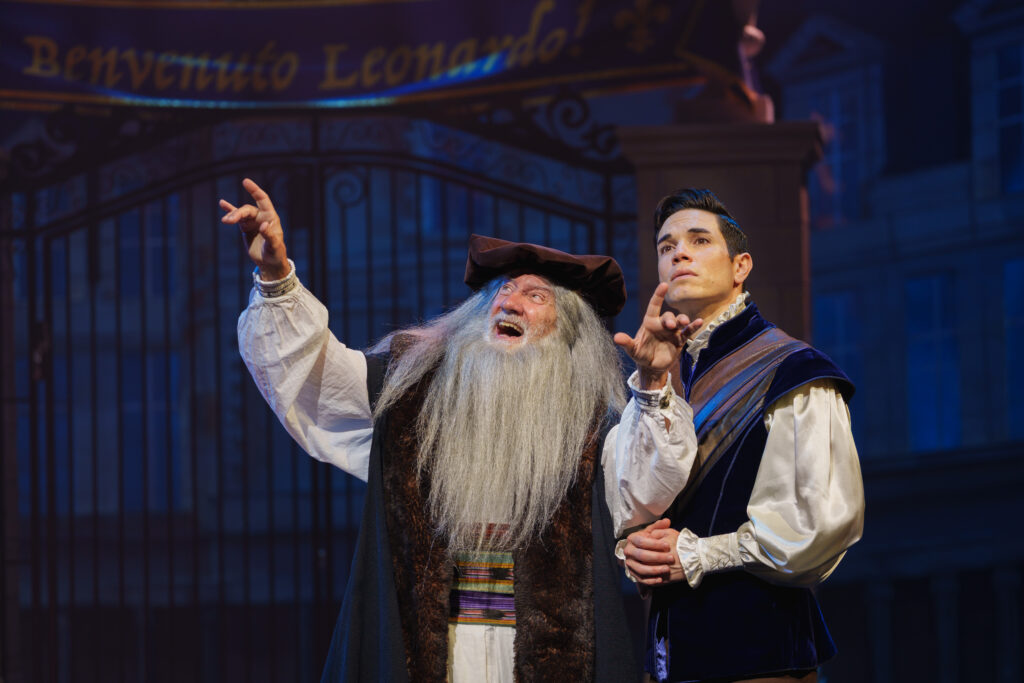
David Garrison* as Leonardo da Vinci and Jason Gotay* as Prince Henry (Photo by Bailey Crawford)
Even Leonardo da Vinci, who fills the narrative role of the fairy godmother, reflects this grounded approach. He does not perform miracles. He provides mentorship, engineering, emotional insight, and practical assistance. His presence shifts the story from fantasy toward humanism and the idea that human potential, intellect, and compassion matter more than divine intervention.
That philosophical framework is woven throughout the show. Danielle repeatedly invokes ideas about freedom, equality, and moral responsibility. Love in Ever After is not destiny. It is recognition. Henry falls in love with Danielle because she reveals a better version of himself to himself. Danielle does not want to be adored as an object, an ornament, or a fantasy. She wants to be known. The desire to be truly seen beyond appearance or social role is one of the most universal human longings imaginable.
And that is ultimately why Ever After resonates.
It is not really about a servant girl marrying a prince. It is about whether people can maintain dignity in systems built on hierarchy and performance. It is about the ache of wanting to be valued for one’s mind and soul. It is about grief reshaping identity. It is about learning courage. It is about discovering that love without respect is hollow.
The show borrows the skeleton of Cinderella, but it fills that skeleton with emotional realism, social awareness, and psychological depth. Fairy tales tend to simplify humanity into symbols. Ever After does the opposite: it insists that even inside a familiar myth, people remain complicated, contradictory, vulnerable, and real.
Details
Dates: May 6 – June 14, 2026
Location: The Phoenix Theatre Company, Dr. Stacie J. and Richard J Stephenson Theatre
Tickets: phoenixtheatre.com | (602) 254-2151
Audio Description and American Sign Language interpretation are available for this production. Performance dates and details can be found at phoenixtheatre.com.
Click here for a PDF of the full article.